
Photograph your palm
One clear shot of your open hand. Camera or gallery. Bright light, lines visible.
Take one clear palm photo. Palmary marks your heart, head, and life lines on the image. You get 3 free observations to read against those marks.
Which part of life would you like to look at first?
Your photo is sent once for the reading, and kaucim.ai does not store the original.
Add the one thing you want to look at. The reading uses it to focus the report.
How it works
One clear shot of your open hand. Camera or gallery. Bright light, lines visible.
Heart, head, life, fate and six others, traced and interpreted in about half a minute.
A clean annotated card you can screenshot, save, or send to the one person who would get it.
Every observation starts with a line visible in your photo. The reading should point back to your palm.
Your photo is sent once for the reading, and kaucim.ai does not store the original. The card is generated on your device. The photo is not reused for other purposes.
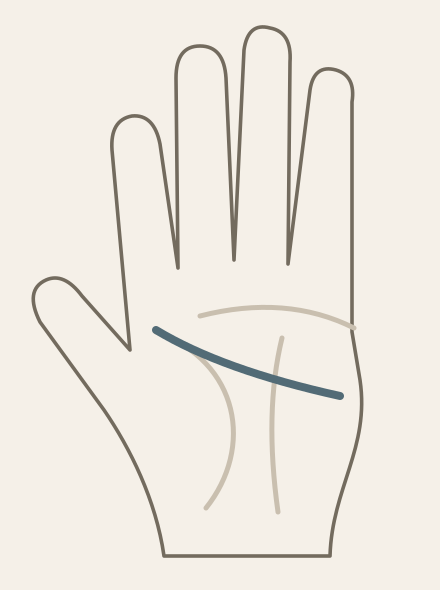
The marked crease crosses the palm from near the thumb and index finger, then slopes slightly toward the little-finger side. Palmistry calls this the head line.
Traditional readings associate a sloping head line with imagination. You could use that as a question about a recent decision. Did you picture the outcome first, or write down the conditions? Your own example gives you something to check the interpretation against.
Your photo is sent for analysis. kaucim.ai does not store the original, and the card is composed on your device.
The English, Japanese and Traditional Chinese previews all show 3 free observations. No account or app installation is needed for the preview. Available paid reports and their current prices appear on your result page.
Palm reading scanner
Upload one real palm photo for a free palm reading online. Palmary reads the visible lines and proportions, shows 3 insights at no cost, and offers a deeper one-time report if the preview feels useful.
Palmary is a photo-based palm reading scanner from kaucim.ai. It reads one real palm photo, returns a free 3-point preview, and can unlock a full 10-point annotated palm reading card.
Yes. Upload one palm photo and Palmary returns 3 palmistry points at no cost, in the browser with no app to install. If a paid one-time report is available for your result, its current price and contents appear after the preview.
Yes, within limits. Palmary reads the visible lines, proportions, and hand shape in one photo, then explains how palmistry traditionally interprets those features.
Neither. The free 3-point preview runs in the browser with no account, no email, and no download. You only reach a checkout if you choose to unlock a paid report.
The free preview covers the life line, head line, and heart line, plus hand shape, any special marks visible in the photo, and one overall note. The full report is 10 positions: those three lines plus the fate line, sun line, Venus mount, moon mount, mercury mount, thumb set, and finger balance, naming where on the palm each point was read.
No. The photo is sent once for reading and is not stored by kaucim.ai. The visual card is composed on your device.
No. Palmary is for reflection, not prophecy. It gives structured palmistry cues and should not replace medical, legal, financial, or safety advice.
How the scan works
Palmary is a palm reading tool that lives in a browser tab. You give it one photograph of an open hand and it returns a free palm reading online: the visible lines marked on your own image, three observations at no cost, and the option of a longer report. What follows is what it does with the picture, and where a human palm reader still reads a hand better.
No. Palmary runs in a browser tab. Open the page on a phone, take or pick one photo, and the reading comes back in the same tab. There is no download and no account, and the card is drawn on your own device. If you have tried a palm reading app before and gave up on the ads and the subscription, this does the same job without either.
It works from what is visible in the photo: the three main creases (heart, head, life), the secondary lines when they show, how full the mounts sit, finger length and taper, and the proportion of palm to fingers. Each of the ten points is marked on your own image, so you can check a claim against the line it came from. Where a feature is faint or cropped out of frame, the reading says the visibility is low.
A good palm reader wins on two things. They can turn your hand under a lamp and see what a flat photo hides, and they can ask a follow-up and change direction halfway through. Palmary reads the same ten points in the same order and marks each one on your photo, so you can check what it looked at. It can still misjudge a faint line, and two photos of the same hand can read differently, so treat each point as something to check against your own hand.
Light coming across the palm at an angle throws the creases into relief, while light straight overhead flattens them. Keep the hand open and relaxed, fill the frame with the palm, and skip the flash, which washes the fine lines out. If the photo is too blurry to read, Palmary asks you for another one rather than reading it.
Start with the hand you write with. Chinese palmistry adds a convention about which hand carries what by age and sex, and the guide below covers it. One clear shot of the open palm in daylight is enough, and you can scan the second hand afterwards to compare the two.
Usually under a minute. The reading itself takes about 15 to 40 seconds, then your device draws the card in another 5 to 15. The first card on a device is the slowest, because the hand-tracking model downloads once and is cached after that. Keep the page open until it finishes. If the download runs long you still get a card, drawn without the line markers on the image.
Yes, and it is one of the better ways to use it. Photograph a friend's open palm the same way and the reading comes back in the same format, which makes two hands easy to hold side by side. Read it to them rather than about them: the point of a palm reading is the conversation it starts, and the person whose hand it is gets the last word on whether any of it lands.
It will not date an event, name an illness, or put a number on how long you will live. Palmistry has no method for any of those. Palmary is written for reflection: each line describes a tendency you can recognise or argue with, and the disagreement is usually the useful part.
Learn palmistry
New to palm lines? These plain, honest guides explain what each line and mark means before you scan. Start with the complete beginner's guide to reading your palm, then read any line in depth.
Try the twelve-question palm reading practice to identify line locations and check photo clarity before comparing your own palm.
Vitality and turning points, including why a short life line does not mean a short life.
How you love: curved or straight, forked or chained, and the common types.
Significant bonds and relationship patterns, not a literal count of weddings.
Direction in work and life, breaks and restarts, and why no fate line is fine.
How wealth is read, from the money triangle to an honest look at billionaire marks.
How Chinese palm reading works, which hand to read, and how it differs from Western.
An honest look at what palmistry can and cannot do, and why it still helps.
The mystic cross, the ring of Solomon, the money triangle, and how rare each really is.
One crease where the heart and head lines merge, and the medical myths around it.