
About kaucim.ai · Hong Kong
Rooted in tradition, with you for what comes next
kaucim.ai is a personal AI guide to Chinese divination, built in Hong Kong. Bring it one thing on your mind, and it uses fortune-stick verses and birth charts to help you see where you stand and find a first step you can take. When things change, you can come back and keep asking.
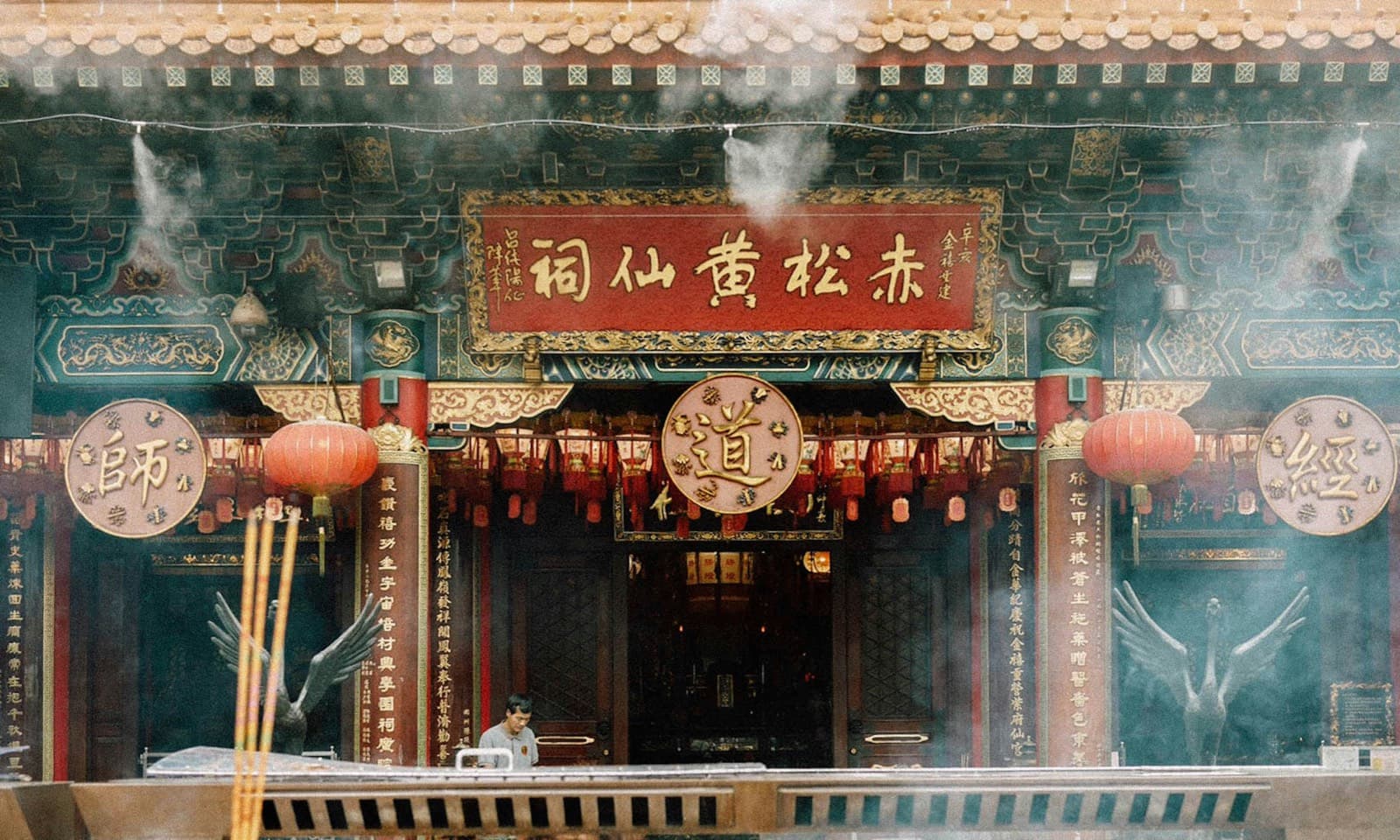
It began with a fortune stick
Outside the red walls of Wong Tai Sin Temple there is often a queue, and people stand in it holding the paper slip for their stick in one hand and a phone in the other. The person who built this site lives about a quarter of an hour's walk away and passes it every day.
The slip carries a verse of four old lines. Stick 56 says no one can be sure this sword will not become a dragon, and that it will leap from the sleeve at the touch of water. Most people who draw it cannot say what those two lines have to do with the matter in front of them. Some walk over to the fortune-tellers' stalls beside the main hall, and others look the number up on their phone.
In April 2026 we went round twelve of those stalls. A basic reading cost HK$30 to HK$80. Some fortune-tellers first asked what work you do and why you want to leave, and only then turned to the stick. Others opened with “Your career luck is good, but watch out for colleagues working against you,” a line that fits anyone. Some people, once the reading was done, were talked into buying a blessed bracelet for a few hundred dollars.
People also ask us why they shouldn't just have a chatbot draw a stick. In September 2026 we asked three chatbots to draw Wong Tai Sin sticks, 87 times in all in Cantonese, and not one line of the verses they wrote matches the temple booklet.
Start with your question
Most of the people who come to ask are between twenty and forty. Many could not tell you whether they believe in it. They want a way to think the matter through from the beginning. Of the questions we read, the most common kind asks whether something will happen.
A good reader listens to your situation before turning to the stick. kaucim set two rules on that basis from the start. The verse stays exactly as the Sik Sik Yuen booklet prints it, and the reading comes back to what you wrote down.
Every Wong Tai Sin stick has a plain-English reading written in advance for seven areas of life: career, wealth, love, health, studies, family, and the matter as a whole. All of them are free. To bring a stick back to your own situation, write down what is going on. Whether to take a new job, whether to get in touch with someone again: a sentence or two is enough, and the reading starts from there.
One question leads to another
The more people asked, the more we saw that one matter usually leads to another. Someone asking whether to change jobs ends up wanting to know what kind of work suits them; someone asking whether to contact a person again ends up wanting to know whether the two of them really get along. Many of the stalls by the temple read palms and birth charts as well as sticks, and an older generation facing these questions would also have a chart drawn up, have two people's birth dates matched, or cast a hexagram.
So kaucim added more over time: the Che Kung and Guan Yin sticks, Zi Wei and BaZi birth charts, a two-person chart comparison, and Qi Men, Plum Blossom and the I Ching. Along the way we met practitioners in Hong Kong for long face-to-face interviews, wrote down how they read a person's situation, and used that record in the model. The site went live on 30 March 2026 with the hundred Wong Tai Sin sticks, and since May 2026, about 30,000 people have used a free reading here.
Things also don't end on the day you ask. Year Companion keeps your chart and the questions you have asked for the whole year. A question from March is taken up again in the June reading, and when your chart reaches a turning point in the month, we email you to come back and look, about a dozen times a year. You can turn those emails off at any time.
The source text, the chart and the reading
Every reading starts from something you can see. Each verse follows its own source. Guan Yin's hundred verses are compared character by character across the Hong Kong and Taiwan traditions, and wherever they differ, the page shows both. Charts are computed from calendar rules, so the same birth time always gives the same chart, and you can compute it again yourself to check. A palm reading marks which part of the hand each point comes from.
The AI writes the reading from that basis and the situation you describe. The interviews with practitioners went into fine-tuning the model, and no practitioner reviews each reading.
After the reading
A stick or a chart gives you a point of reference, and the doing is still yours. Whether to talk to that person once more, which terms of a new job to pin down first: we can't decide those for you.
After you draw a stick, the page asks what you plan to do. Write a line, and thirty days later come back and check it. What you are checking is what you did after that.
A few things we will keep to. No verse will be changed by a single character, and the plain-language readings stay free. One birth time will only ever give one chart here. And who writes the readings, and from what, is set out on this page.
KAUCIM.AI
Start with what matters to you now
You don't need to have it all worked out. Bring one question.
The team and the service
Is asking a chatbot enough?
People ask why they should draw a stick or build a chart here when a chatbot will do it for free. In September 2026 we tested ChatGPT, Claude and Gemini through their model APIs with web search turned off, and kept every prompt and every answer.
Asked in English to draw one Wong Tai Sin stick, ChatGPT drew 20 times and gave only 7 different numbers, with stick 47 coming up 7 times. A fair draw of 20 from 100 sticks shows about 18 different numbers. Claude declined 19 of the 20 requests, saying it could not draw at random. We ran the same test in Cantonese with 30 draws per model. ChatGPT gave 12 numbers, Claude gave stick 23 twenty-four times, and in 87 draws the three models wrote no line of verse that matches the temple booklet. Asked for the titles of 20 sticks, ChatGPT named 2 correctly and gave stick 8, which the booklet grades lowest, the highest grade.
Moon blocks came out skewed too. Two real blocks land one flat and one round about half the time, and each of the other two results about a quarter of the time. ChatGPT, asked in English, gave that first result 19 times out of 20. Claude, asked in Cantonese, gave it 28 times out of 28.
Charts depend on the model. For twelve Hong Kong birth times given in English, ChatGPT got all four BaZi pillars right six times, while Claude declined nine times and got the other three wrong. Asked in Chinese about the Zi Wei Life Palace, ChatGPT placed it and its stars correctly for 8 of 10 births and Claude for none. Most people ask once and cannot tell whether that answer was one of the right ones.
Here the five stick systems give every stick the same chance, and each verse is the one its source publishes, with variants shown side by side. Each moon block falls on its own, so the mixed result comes up about half the time and each of the other two about a quarter. Charts come from iztro and lunar-typescript, and one birth time always gives one chart.
People also ask why they should pay for a reading when a chat assistant will read a chart for free. A chat assistant recites the chart from memory, and in our tests the day pillar was the one it got wrong most often. A reading here is written against the computed chart, cross-reads BaZi and Zi Wei on the same birth, carries the current decadal and annual timing from the engine, and stays where you can find it again. Whether that is worth the price is your call, and the free chart lets you decide with the chart in front of you.
If you want to talk a reading through with a chatbot, draw or build the chart here first, then paste the stick number, the original verse or the whole chart. An assistant can also call our free draw and chart endpoints and get a real stick or a computed chart. We have not run the same test on palm reading, room scans or dream readings, so we make no claim about them here. The draw test is written up in Chinese fortune sticks online.
More readings
Letters
Write to us
Tell us about a partnership or an interview, a mistake in a verse or a translation, or anything else on your mind. We reply to the email address you leave.